

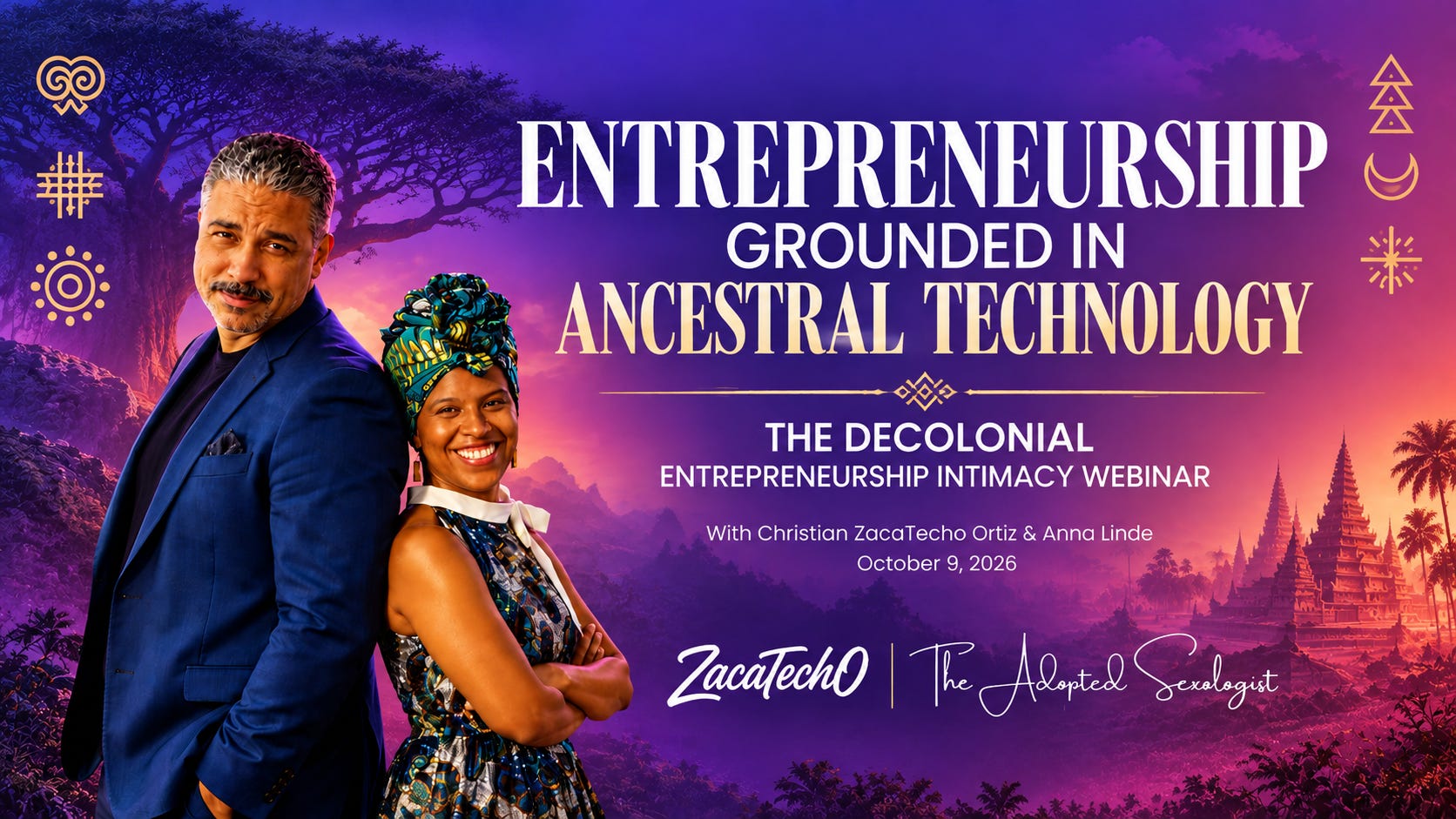
This article is part of a collaborative series between myself, Afro-Indigenous Decolonial Social Scientist Christian ZacaTecho Ortiz, and Anna Linde, found here Anna | Sexologist (MSc), a Sexual and Reproductive Health and Rights Specialist, Sexologist (MSc), and practitioner of Dance and Movement Therapy. Our work moves across global contexts and meets at the intersections of decolonization, intimacy, embodiment, identity, desire, entrepreneurship, and the systems that shape how people relate to themselves, their work, their money, and their power.
We’re bringing these conversations together because entrepreneurship is never only about business. It lives in the body. It moves through the nervous system. It activates inherited survival strategies, visibility wounds, questions of worth and belonging, sexuality, ambition, money, control, trust, and the parts of ourselves that become exposed when we decide to build something of our own. Entrepreneurship can become a site where power, desire, intimacy, ancestry, and identity collide, and that collision deserves more than strategy language. It deserves a deeper conversation about what we carry, what we reproduce, what we’re ready to transform, and what becomes possible when we build from a different relationship to ourselves.
On October 9, 2026, we’re hosting The Decolonial Entrepreneurship Intimacy Webinar.
This webinar is an entry point into a larger body of work we’re developing around entrepreneurship, intimacy, ancestral technology, desire, money, power, visibility, and the shadow material that surfaces when we begin building beyond survival. We’ll also be offering an eight-week course focused on Decolonial Entrepreneurship and the Shadow Work of Entrepreneurship, where we’ll go deeper into the personal, relational, somatic, ancestral, and structural patterns that shape the way we build.
This work begins from a simple truth. We don’t rise to the level of our intentions. We fall to the level of our systems, and most of us inherited systems that were never designed for our liberation, safety, pleasure, wealth, rest, or sovereignty. We inherited economic systems built through extraction, workplaces organized around obedience, definitions of professionalism shaped through racial hierarchy, and relationships with productivity that taught us to measure our worth through output. We inherited stories about money, ambition, visibility, leadership, desire, success, and belonging long before we had enough language to question who those stories served. Entrepreneurship doesn’t automatically free us from any of this. We carry these systems with us until we become conscious enough to recognize what we’re reproducing, what we’re ready to change, and what we’re ready to build.
Colonialism didn’t disappear when formal empires changed shape. Coloniality remained embedded in institutions, markets, property relationships, labor expectations, knowledge systems, gender hierarchies, borders, education, and definitions of legitimacy. We live inside those conditions while trying to create lives that exceed them. That contradiction doesn’t disqualify the work. It is the material we’re working with. I’m not interested in purity politics that demands an impossible innocence from people attempting to build differently inside systems they didn’t create. There is no pure economy waiting for us, no untouched marketplace, no perfectly decolonized business model capable of lifting us outside history, and no ancestral past without contradiction. Our ancestors were human beings living within complex societies, making choices, navigating conflict, creating systems, changing them, and carrying contradictions of their own. Romanticizing them into perfect beings doesn’t honor them. It turns ancestry into mythology and liberation into another impossible performance.
Purity was never the point. Governance, consent, accountability, refusal, relationship, power redistribution, and material capacity are the work. Decolonization isn’t a certificate of ideological cleanliness. It’s an ongoing struggle over who has the power to decide, who controls resources, whose knowledge is recognized, whose labor is compensated, whose boundaries carry consequences, whose bodies receive protection, and whose futures are considered worth building. We’re going to make imperfect decisions inside compromised systems because there is no location outside history from which to begin. The demand for purity can become another technology of paralysis, keeping people occupied with proving their goodness while institutions continue accumulating land, capital, infrastructure, intellectual property, technological power, and decision-making authority.
This is where entrepreneurship becomes interesting to me. I’m not interested in entrepreneurship as another pathway toward becoming more consumable. I’m interested in entrepreneurship as system-building. A business is a system. Pricing is a system. Visibility is a system. Boundaries are a system. Offers are a system. Collaboration is a system. Rest exists within systems. Our relationships with clients, employees, partners, audiences, money, technology, time, knowledge, and ourselves are shaped through systems. Even our nervous systems interact with the conditions we create around them. Building a business gives us an opportunity to become conscious of those systems and decide what they’re going to organize our lives around.
Ancestry is technology too. Technology is organized knowledge applied toward life, and the machine doesn’t own that definition. Human beings have always developed technologies for agriculture, navigation, architecture, medicine, birth, food preservation, ecological stewardship, education, trade, governance, conflict resolution, spirituality, storytelling, collective memory, art, relationship, community care, and survival. Our ancestors built systems because human beings have always built systems. Colonialism encountered sophisticated worlds of knowledge and reorganized which forms of intelligence would be recognized as legitimate. Knowledge was stolen, suppressed, renamed, commodified, criminalized, extracted, or dismissed while colonial institutions installed themselves as authorities capable of deciding what counted as knowledge in the first place.
Understanding ancestry as technology changes what entrepreneurship can mean. Entrepreneurship no longer has to begin with the question of what we can package, brand, scale, or sell. It can begin with what we’re here to build, what we’re here to protect, what knowledge we’re responsible for carrying, what resources need to move, what relationships we’re responsible to, what we’re willing to refuse, and what becomes possible because we acted on our desire. Calling can become larger than career because our lives are larger than careers. Purpose doesn’t have to be reduced to a job title, monetizable talent, niche, personal brand, or perfectly optimized zone of genius. We can understand purpose through relationship, responsibility, creativity, land, community, ancestry, spirituality, pleasure, collective need, and the futures we want to help make possible.
Ancestral technology also requires boundaries. It isn’t a free archive of practices waiting to become intellectual property, content, products, retreats, courses, or brand aesthetics. Lineage matters. Nation matters. Community matters. Consent matters. Protocol matters. Relationship matters. Some knowledge is meant to travel widely, while other knowledge carries responsibilities that can’t be separated from the people who hold it. Some knowledge isn’t ours to commercialize, digitize, automate, package, translate, or sell. Decolonial entrepreneurship requires enough relational maturity to understand that access doesn’t create entitlement. Reclaiming ancestral intelligence cannot become another excuse for extraction wearing more beautiful language.
We also have to stop treating scarcity as the natural inheritance of people whose resources were systematically taken from them. Scarcity has been manufactured through stolen land, stolen labor, displacement, dispossession, segregation, extraction, racial hierarchy, gendered control, unpaid care work, suppressed wages, destroyed community systems, spiritual suppression, restricted access to education, and the concentration of capital into institutions that were never neutral about who deserved to possess it. Generations of people learned how to survive those conditions with extraordinary creativity, but survival under manufactured scarcity should never be confused with proof that scarcity is culturally authentic.
This matters because many of us have been taught to distrust our own desire. We’ve learned to interrogate wanting money, freedom, pleasure, visibility, influence, spaciousness, land, beauty, support, and rest as though desire itself is politically suspicious. We’ve been taught that wanting more means capitalism has corrupted us, while institutions built through accumulation continue possessing enormous material power without undergoing the same moral interrogation. I refuse the idea that people who’ve inherited histories of dispossession have to perform detachment from abundance to prove their commitment to liberation. Desire can contain information about what has been denied, what needs protection, what wants expression, and what kind of life we’re trying to make materially possible.
Money matters because material conditions matter. Money can create access to housing, food, healthcare, education, technology, land, transportation, legal support, art, childcare, elder care, rest, travel, safety, experimentation, and time. Money can create room to leave relationships, workplaces, clients, institutions, and environments that demand self-abandonment. Money can fund businesses, community infrastructure, creative work, mutual support, political imagination, and futures that would otherwise remain dependent on institutions with different priorities. None of this makes money pure. It makes money material. We don’t need to worship it or pretend it is spiritually meaningless. We need enough consciousness to understand what it allows us to build, protect, refuse, and sustain.
I want our money back. I want the wealth disappeared through stolen land, stolen labor, stolen wages, extraction, segregation, displacement, unpaid care work, suppressed opportunity, racialized pricing, gendered labor, appropriated intellectual property, and generations of brilliance being treated as less valuable. I want resources moving toward our homes, our health, our art, our pleasure, our land, our elders, our children, our technologies, our communities, and whatever futures we decide deserve to exist. I don’t need to sanitize that desire by pretending I only want enough to survive comfortably. I want abundance large enough to create choices, infrastructure, protection, experimentation, generosity, refusal, and rest.
That doesn’t require pretending wealth automatically becomes liberation when it reaches our hands. We carry history into our relationship with money. We carry conditioning, fear, desire, scarcity, status, wounds, longing, responsibility, ego, memory, and imagination. A person can leave an extractive workplace and reproduce the same conditions inside their own company because changing ownership doesn’t automatically change the system. Entrepreneurship gives us an opportunity to examine what we’re reproducing without demanding perfection from ourselves. Accountability has to remain possible because mistakes will remain possible. Contradiction has to remain survivable because contradiction is part of building anything inside the world we actually inhabit.
The same is true of survival adaptations. Hypervigilance may have helped someone anticipate danger and later make delegation nearly impossible. Radical independence may have protected someone from unreliable people and later make receiving support feel threatening. Urgency may have helped someone survive unstable conditions and later become the rhythm through which they burn themselves out. These aren’t character failures. They’re intelligent adaptations that can outlive the conditions that produced them. Entrepreneurship can expose those adaptations because business touches money, visibility, rejection, authority, boundaries, dependence, risk, desire, receiving, responsibility, and uncertainty all at once. The business becomes a place where our histories meet our ambitions.
That is why entrepreneurship can become intimate work. We aren’t only building offers, audiences, products, services, and revenue. We’re building relationships with power. We’re discovering what happens when we become visible enough to be judged, paid enough to have choices, supported enough to release hyper-independence, and resourced enough to imagine beyond survival. We’re learning what happens when desire stops being hypothetical and begins asking something material from us. The systems we build around that desire determine whether our businesses become another place where we abandon ourselves or a place where we practice another relationship with power.
There is no decolonial purity waiting at the end of that process. We’re going to use technologies produced inside systems we critique. We’re going to exchange currencies shaped by histories we didn’t choose. We’re going to participate in markets whose rules were written before we arrived. We’re going to encounter compromises, contradictions, failures, competing responsibilities, and decisions that refuse to resolve themselves into perfect political answers. That reality doesn’t make the work meaningless. It makes governance necessary. We have to keep asking who holds power, who carries the cost, who receives the benefit, who gets to decide, whose knowledge is being used, whose labor is being compensated, whose boundaries matter, and what we’re unwilling to sacrifice for growth.
Our ancestors didn’t leave us a perfect blueprint for twenty-first-century entrepreneurship, and they didn’t need to. They left evidence that human beings have always created systems for living, relating, exchanging, remembering, feeding, protecting, celebrating, grieving, teaching, governing, and imagining. We don’t need to cosplay the past to access that inheritance. We need to recover our authority to think of ourselves as builders. We can carry ancestral intelligence forward while creating forms our ancestors never encountered and possibilities they never had the material conditions to build.
That is the ground of the Decolonial Intimacy Lab and the work we’re bringing into the Decolonial Entrepreneurship Intimacy Webinar on October 9. It’s for entrepreneurs, creatives, practitioners, and people at the beginning of entrepreneurship who know they’re building more than a business. It’s for people examining what they inherited, what they’re reproducing, what they’re refusing, what they desire, and what kinds of systems can hold the lives they’re trying to create. The eight-week course that follows will take this work further into the Shadow Work of Entrepreneurship, where ambition, money, visibility, power, intimacy, survival, fear, desire, control, receiving, and self-concept all become part of the conversation. This work isn’t about becoming pure enough to deserve success. It’s about developing the capacity to hold power, resources, visibility, pleasure, responsibility, relationship, contradiction, and desire without surrendering our humanity to the systems that taught us what success was supposed to look like.
Your desire isn’t too much. Your ambition isn’t evidence that capitalism corrupted you. Wanting money doesn’t make you less committed to liberation. Wanting pleasure doesn’t make you unserious. Wanting visibility doesn’t make you vain. Wanting influence doesn’t make you dangerous. Wanting rest doesn’t make you lazy. Wanting more than survival doesn’t betray the people who survived before you. Desire can be one of the mechanisms through which we recognize what we’re ready to protect, resource, experience, and build.
Entrepreneurship grounded in ancestral technology begins there. We remember that our people were builders before colonial institutions appointed themselves the arbiters of intelligence. We refuse the demand to become politically pure before we’re allowed to desire material power. We build inside contradiction because contradiction is where life is happening. We stay accountable because power without accountability reproduces harm. We remain in relationship because liberation severed from relationship becomes another form of individualism. We move resources because ideas without material capacity remain vulnerable to whoever already controls the infrastructure. We refuse what requires our disappearance. We create what our lives are asking us to create. We stop treating survival as the highest future available to us.
Our ancestors endured worlds designed to constrain what they could possess, imagine, inherit, build, and become. We don’t honor that history by making deprivation sacred. We honor it by building futures spacious enough to contain everything survival couldn’t.
What times? Where to sign up? 🙏
Wonderful perspectives!